@IndianEmbJktIndonesia has released a special commemorative stamp on the theme of Ramayana to mark the 70th anniversary of the establishment of its diplomatic ties with India.
In a statement, the Embassy of India in Jakarta yesterday said the stamp, designed by renowned Indonesian sculptor Padmashri Bapak Nyoman Nuarta, featured a scene from Ramayana in which Jatayu valiantly fought to save Sita.
A specially signed version of the stamp will be on display at the Philately Museum in Jakarta, it said.
India’s Ambassador Pradeep Kumar Rawat and Indonesia’s Vice Foreign Minister Abdurrahman Mohammad Fachir attended the event.
Kim Jong Un to meet Putin
Kim Jong Un will meet Vladimir Putin on Thursday.
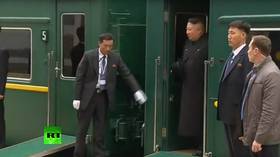
Kim Jong Un arrived in Russia for a summit with President Vladimir Putin, the meeting coming just two months after the North Korean leader’s meeting with US President Donald Trump in Vietnam that ended abruptly.
Kim Jong-un’s armored train has reached Vladivostok, a city in Russia’s Far East, which will host the first-ever meeting between Kim and President Vladimir Putin.
The summit, which is scheduled for Thursday, will be hosted by the Far Eastern Federal University at its new campus on Russky Island, which is across the bridge from Vladivostok.
The program of the visit has largely been kept secret, but evidence of preparations for the high-profile meeting has been floating around since Monday.
Two leaders failed summit in Vietnam meant that Kim was unable to get the sanctions relief he sought from the United States. He is unlikely to get that in his meeting with Putin as well.
But while Russia fully enforces the sanctions it voted to impose on Pyongyang, it has joined China in calling for loosening the punishment in recognition of steps taken in limiting North Korea’s weapons testing.
Kim has two urgent concerns as he heads to the summit – North Korean labourers in Russia and the food shortage in his country.
Around 10,000 North Korean labourers are still employed in Russia. All of them will have to leave the country by the end of the year as a 2017 UN sanctions resolution takes effect.
The labourers, who previously numbered as many as 50,000, provided Pyongyang with more than $500m in foreign exchange annually, according to documents seen by Reuters news agency.
“Maybe, the numbers will stop decreasing after Kim’s visit,” said Dmitry Zhuravlev, director general of the Institute of Regional Issues in Moscow.
The labourers’ presence is crucial in Russia’s underpopulated provinces that have plenty of fallow land, timber and natural resources but they are “large enough and there is enough room for the Koreans”, added Zhuravlev.
Kim is also looking at the possibility of a food shortage in North Korea this summer. Russia has shown a willingness to provide humanitarian aid.
Last month, it announced it had shipped more than 2,000 tonnes of wheat to the North Korean port of Chongjin.
Turkey’s high election board has rejected part of an effort by President Recep Tayyip Erdogan’s ruling party to have a re-run of elections in Istanbul. The appeal regarded voters who were dismissed by decrees from government jobs after an attempted coup in 2016, Anadolu reported. In a petition submitted to cancel and re-run the city elections that it lost three weeks ago, Erdogan’s AK Party cited thousands of ballots cast by people it said were ineligible to vote due to previous government decrees. Based on initial results and recounts, the main opposition Republican People’s Party (CHP) won the election in Istanbul, Turkey’s largest city, with a margin of some 13,000 votes. The new CHP mayor, Ekrem Imamoglu, took office on Wednesday, despite a formal request submitted a day earlier by the AKP to annul and repeat the mayoral elections over what it said were irregularities. The high election board, the YSK, has not yet ruled on the appeal to annul and rerun the elections due to voting irregularities including faulty entering of voting data, Reuters said.
Zelenskiy’s victory an ‘important moment’
Trump calls comedian Zelenskiy’s win an ‘important moment’ in Ukraine’s history: White House: President Trump spoke to newly elected Ukrainian president Volodymyr Zelenskiy Sunday night,
Zelenskiy’s victory is widely seen as a rebuke of the status quo, a response to perceived corruption within the political establishment and with nearly all the ballots counted, the 41-year-old Volodymyr Zelenskiy took 73% of the Ukrainian vote shows his profound following in the country.
He being able win parliamentary elections in October and the support of oligarchs will be crucial for prospective President Zelensky.
Zelenskiy has the right to propose certain cabinet jobs, like that of foreign minister, but much of the current government is likely to remain in place until the next parliamentary election, which is due in October.
The United States, the European Union and Russia will be closely watching Zelenskiy’s foreign policy pronouncements to see if and how he might try to end the war against pro-Russian separatists that has killed some 13,000 people.
U.S. President Donald Trump phoned Zelenskiy and pledged to support Ukraine’s territorial integrity. German Chancellor Angela Merkel echoed that support for Ukraine’s territorial integrity, saying in a letter she looked forward to hosting Zelenskiy for talks in Berlin soon.
The European Union delivered formal congratulations to Zelenskiy but made clear it expects him to pursue reforms.Zelenskiy said on Sunday he planned to continue European-backed talks with Russia on a so-far largely unimplemented peace deal and would try to free Ukrainians imprisoned in Russia, including 24 sailors.
The Kremlin said it was premature to talk of President Vladimir Putin congratulating Zelinskiy or about the possibility of the two leaders working together.
“We’ll be able to judge by concrete deeds,” Dmitry Peskov, Putin’s spokesman, told reporters.
Peskov said Moscow respected the choice of the Ukrainian people, but said there was a question mark over the legitimacy of the election because Kiev did not allow some 3 million Ukrainians living and working in Russia to vote.
The most important reason why I'm here, Mr. President,' Khan said, addressing Iran's President Hassan Rouhani, 'is because I felt that the issue of terrorism was going to ... increase differences between our countries.'
The Pakistani guest made a commitment concerning militants using his country's soil near the border as a safe haven: 'We trust that both countries will not have terrorist activities from their soil,' he said. 'We will not allow any damage to your country from our soil.'
Imran Khan, along with a delegation, was on his maiden two-day official visit of Iran, at the invitation of Iranian President Rouhani, to strengthen bilateral and commercial relations.
Imran Khan also met with Iran´s Supreme Leader Ayatollah Ali Khamenei, who called for the 'strengthening of relations in spite of the will of enemies.'
Ayatollah Khamenei blamed those unnamed 'enemies' for the attacks on both sides of the Iran-Pakistan border, which the supreme leader said were intended to 'contaminate' relations between the two Muslim nations.
“We will cooperate with each other in helping political settlement of Afghan issue as peace in the war-torn country will help both Pakistan and Iran, the prime minister said. Iran and Pakistan have agreed to set up a joint border 'reaction force' following a number of deadly attacks by militant groups on their frontier, Iranian President Hassan Rouhani announced on Monday after talks with visiting Pakistani Prime Minister Imran Khan.
'We agreed to create a joint rapid reaction force at the borders for combating terrorism,' Rouhani told a joint news conference, following months of increased tensions over attacks on both sides of the frontier.
'The security chief will sit down with his counterpart here and discuss (security) cooperation,' Khan said, although no details were given on the joint force. 'We trust that both countries will not have terrorist activities from their soil ... We will not allow any damage to your country from our soil,' said the Pakistani premier.
Stressing that 'no third country' could harm Iran-Pakistan ties, an apparent reference to the United States and its policy of isolating the Islamic republic, Rouhani said Tehran was ready to boost trade and business ties with Islamabad.
'In the current situation, the region’s countries must decide and plan for their interests independently and directly,' Rouhani said. For his part, Khan said his visit to Tehran aimed to 'find ways to increase trade and cooperation... in energy and other areas', noting that two-way trade was 'very limited'.
The joint statement issued after the conclusion of Prime Minister Imran Khan's two day official visit to Iran said both sides reiterated the importance of deepening and reinforcing bilateral ties based on principles of national interest, territorial integrity and mutual respect for national sovereignty.
Both sides highlighted that common borders should be the borders of peace and friendship, and acknowledged the necessity of forging regular cooperation and exchange of views between political, military and security officials of the two countries to combat threats such as terrorism, smuggling of narcotics, human trafficking, hostage-taking, money-laundering and abduction. It was also agreed that the 10th Round of the Special Security Committee of the two Ministries of Interior will be held in Islamabad in June 2019 to discuss these matters in detail.
They called for swift implementation of bilateral agreements as a step towards realizing this important goal.
Both sides acknowledged the necessity of forging regular cooperation and exchange of views between political, military and security officials of the two countries to combat threats such as terrorism, smuggling of narcotics, human trafficking, hostage-taking, money-laundering and abduction.
They called for swift implementation of bilateral agreements as a step towards realizing this important goal.
It was also agreed that the 10th Round of the Special Security Committee of the two Ministries of Interior will be held in Islamabad in June 2019 to discuss these matters in detail.
It was also agreed that the next meeting of the Joint Consular Commission would be held on 2nd half of 2019 to review the progress made so far and chart the way forward in further facilitating the movement of people from both sides. Pakistan side welcomed the initiation of the process for release of a number of Pakistani prisoners by the government of Iran, and for making arrangements for their expeditious repatriation to Pakistan.
President of the Islamic Republic of Iran and Prime Minister of the Islamic Republic of Pakistan agreed that enhancing and cementing cooperation between Iran’s Sistan Baluchestan Province and Pakistan’s Balochistan Province including opening of new border crossings and border markets would contribute towards improvement of the economic situation of local residents, and further constitutes a step towards resolving border challenges and insecurities.
Both sides agreed to hold the 2nd Round of High Border Commission in Islamabad in May 2019 to review the current status of preparations and further measures required for the earliest opening of new crossing points at Gabd-Reemdan and Mand-Pishin, besides opening of new border markets.
Primary objective of ‘Agriculture Extension’ is to ensure that Indian Farmers get best of the world ‘Agriculture Skills and Inputs’ to get world’s best Crop Yields. There is huge yield gap between World’s Best Country Average and India Average and between India’s Best and India’s Worst.
Very high ‘TEN FOLD YIELD GAP’ indicates Gross Failure of Agriculture Extension Service in India. World’s Highest STUNTED & WASTED Children or Half of the World.
When average yield of Corn in USA is 10,572 kg per hectare, peak in some regions 15,000 kg, India Maize yield is 2664 kgand some Indian states just 1564 kg for Rajasthan. Similarly USA groundnut yield is 4442 kg, best in USA around 6000 kg, India yield 1425 kg and 624 kg in Karnataka.
As per latest Agriculture Statistics – 10 Cr Farm Holdings or 50 Cr Farmers in India have no Bank Credit service, 4 Cr Farm Holdings or20 Cr Farmers use no FERTILIZER, 12 Cr Farm Holdings or 60 Cr Farmers have no Canal Irrigation.
Upto 1966 or first 20 years after Independence FARMING WAS PRIMITIVE – Low Yield Seeds, Minimum Pesticide Use in spite of Locust Attacks, Persian Wheels for Irrigation, Animal Power Ploughing and Manual Harvesting.
MS Swanimathan imported HY RED WHEAT from Mexico in 1966which had TRIPLE Yield in Irrigated and Fertilized Farmsbut Red Wheat didn’t suit Indian preference for White Bread or Roti. 18,000 Tones of Wheat Seeds were not CLEANED and Processing – brought with it ALIEN WEEDS. It was years of Local Breading to IMPROVE COLOR/TASTE.
2007-2012 – States Reporting Highest MILK PRODUCTION also report substantial growth in Live Stock Numbers. ‘Livestock population has increased substantially in Gujarat (15.36%), Uttar Pradesh (14.01%), Assam (10.77%), Punjab (9.57%) Bihar (8.56%); Sikkim (7.96%), Meghalaya (7.41%), and Chhattisgarh (4.34%)’.
Out of 300m Cattle & Buffalo approx. only 80m Are in MILK – only about 27% Yield Milk. Only 20m are Exotic/Cross Bred Cows i.e. JUST 6% of Bovine Population.
Other issues were already covered in my 5 Chapter report – pdf attached.
INVENTING INDIA THINK TANK - INNOVATIVE TECHNOLOGIES & PROJECTS